Sic Bo (2026): Rules, Bets, Dice Odds, Payouts & Safety
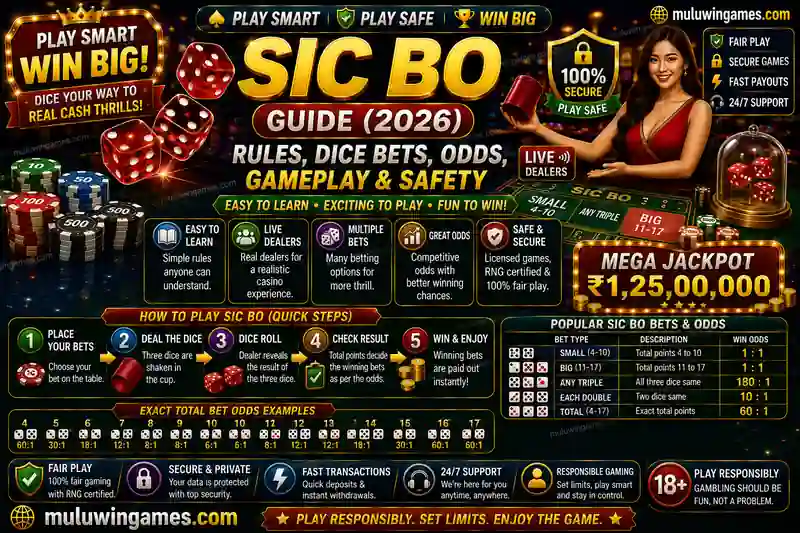
Sic Bo Guide (2026): Rules, Dice Bets, Odds, Gameplay & Safety
Sic Bo is a dice-based casino game built around the result of three dice. Players do not roll the dice themselves in most casino or live-dealer versions. Instead, they choose from a range of betting options before the dice are revealed. Those bets can be based on the total of all three dice, whether certain numbers appear, whether the total is odd or even, or whether the dice form a specific combination.
This independent 2026 Sic Bo guide explains the core rules, the role of the three dice, common bet categories, basic probability concepts, live-game features, common misunderstandings and responsible-gaming principles. Muluw.in is an independent informational gaming website and is not presented as the official Mulu Win website or the operator of any Sic Bo game.
AI Summary: Sic Bo in Simple Terms
Sic Bo is normally played with three dice. Before each round, players choose from available wagers such as Small, Big, Odd, Even, specific totals, single numbers, doubles or triples. The dice are then rolled or shaken, and all eligible bets are settled according to the result and the table’s rules.
The game is easy to understand at a basic level, but the different bet types have very different probabilities and payout structures. A higher displayed payout generally means the required outcome is more specific and less frequent. No strategy, streak chart or prediction tool can guarantee the next three-dice result.
Key Takeaways
- Sic Bo is commonly played with three dice.
- Players select wagers before the dice result is known.
- Common bets include Small, Big, Odd, Even, totals, single numbers, doubles and triples.
- Different bet categories have different probabilities and payout conditions.
- A higher payout does not automatically mean a better bet.
- Triple results can affect the settlement of some broad wagers, depending on the table rules.
- Past rolls do not guarantee the next result.
- No dice pattern, AI predictor or betting progression can guarantee winnings.
- Players should read the exact table rules before participating.
- Real-money play should always involve spending and time limits.
What Is Sic Bo?
Sic Bo is a three-dice game commonly associated with Asian casino gaming. The name is often translated as meaning something similar to “dice bowl,” although modern casino versions are usually presented through a digital interface or live-dealer table rather than a traditional physical setup.
The core concept is straightforward. Three dice are rolled, and players try to predict different characteristics of the combined result. Unlike Dragon Tiger or Baccarat, Sic Bo does not use playing cards. Unlike Roulette, it does not use a numbered wheel and ball.
Because the game offers many types of wagers at once, the betting layout can initially look complicated. However, most options fall into a small number of logical categories.
How Sic Bo Works
A standard Sic Bo round usually follows this sequence:
- The betting period opens.
- Players choose from the available Sic Bo bets.
- The countdown ends and betting closes.
- Three dice are rolled, shaken or revealed.
- The dice values are combined and evaluated.
- Eligible winning wagers are identified.
- Wagers are settled according to the displayed payout rules.
- A new betting round begins.
Live and digital versions may use different animations, interfaces or dice-delivery systems, but the main principle remains the same: the result comes from three dice.
The Three Dice in Sic Bo
Each standard die has six possible faces numbered from 1 to 6. Since Sic Bo uses three dice, the combined total can range from 3 to 18.
| Lowest Possible Roll | Highest Possible Roll |
|---|---|
| 1 + 1 + 1 = 3 | 6 + 6 + 6 = 18 |
The fact that three dice are used means there are many possible combinations. Some totals can be formed in more ways than others, which is why not every total has the same probability.
Common Sic Bo Bet Categories
The betting layout can vary by provider, but most Sic Bo games include some combination of the following wager types:
- Small
- Big
- Odd
- Even
- Specific totals
- Single-number bets
- Double bets
- Triple bets
- Combination bets
Each category works differently and can have a different mathematical profile.
What Is a Small Bet in Sic Bo?
A Small bet generally predicts that the total of the three dice will fall within a lower range. A common range is 4 through 10, although the exact rule must be checked on the specific table.
Many Sic Bo versions also include an important condition: a triple may cause Small to lose even if the total would otherwise fall within the Small range.
For example:
- 2 + 3 + 4 = 9 → typically Small
- 1 + 2 + 6 = 9 → typically Small
- 3 + 3 + 3 = 9 → may be excluded because it is a triple
This triple exception is one of the most important rules beginners should understand before using broad Sic Bo bets.
What Is a Big Bet?
A Big bet generally predicts that the total of the three dice will fall within a higher range. A common range is 11 through 17, although table-specific rules apply.
As with Small, many versions exclude triples from winning Big bets.
Examples:
- 5 + 4 + 3 = 12 → typically Big
- 6 + 6 + 4 = 16 → typically Big
- 5 + 5 + 5 = 15 → may be excluded because it is a triple
Small vs Big in Sic Bo
| Bet | Typical Meaning | Important Note |
|---|---|---|
| Small | Total usually falls in the lower range | Triples may be excluded |
| Big | Total usually falls in the higher range | Triples may be excluded |
The exact total ranges and triple settlement rule should always be confirmed using the table’s own help or rules section.
Odd and Even Bets
An Odd wager predicts that the combined total of the three dice will be an odd number. An Even wager predicts an even total.
For example:
- 2 + 4 + 5 = 11 → Odd
- 1 + 3 + 6 = 10 → Even
Some Sic Bo versions apply a triple exception to Odd and Even as well. This means that a result such as 3-3-3 may not settle as a normal Odd win even though the total is 9.
Again, the table rules should be treated as the primary source for settlement details.
Specific Total Bets
A specific-total wager predicts the exact sum of all three dice.
Possible totals range from 3 to 18. However, the middle totals can be formed by more combinations than the extreme totals.
For example:
- Total 3 can only occur as 1-1-1.
- Total 18 can only occur as 6-6-6.
- Total 10 can occur through many different combinations.
This is why payout amounts for exact totals often differ. A total that is more difficult to obtain can be associated with a larger payout.
Example Specific Totals
| Dice | Total |
|---|---|
| 1-2-3 | 6 |
| 3-3-4 | 10 |
| 4-5-5 | 14 |
| 6-6-5 | 17 |
What Is a Single-Number Bet?
A single-number bet predicts that a chosen number will appear on at least one of the three dice.
For example, a player chooses the number 4.
- Result 4-2-6 → number 4 appears once.
- Result 4-4-1 → number 4 appears twice.
- Result 4-4-4 → number 4 appears three times.
Some tables adjust the payout depending on whether the selected number appears one, two or three times. The exact payout schedule varies and should be checked before betting.
What Is a Double Bet?
A Double wager predicts that two of the dice will show a particular matching number.
Examples include:
- Double 2
- Double 4
- Double 6
If someone selects Double 4, the winning condition generally requires at least two dice to show 4, subject to the specific table rules.
Because this is more specific than simply predicting that a 4 appears once, the payout is commonly higher.
What Is a Triple Bet?
A Triple means that all three dice show the same number.
Examples include:
- 1-1-1
- 2-2-2
- 3-3-3
- 4-4-4
- 5-5-5
- 6-6-6
Triples are important because they can affect broad bets such as Small, Big, Odd or Even depending on the game rules.
Specific Triple vs Any Triple
Some Sic Bo tables offer two different triple-related wagers.
Specific Triple
This predicts one exact triple, such as 5-5-5.
Any Triple
This predicts that all three dice will match, regardless of the number.
| Bet Type | Example Winning Result |
|---|---|
| Specific Triple 4 | 4-4-4 only |
| Any Triple | 1-1-1, 2-2-2, 3-3-3, 4-4-4, 5-5-5 or 6-6-6 |
A specific triple has more restrictive winning conditions than Any Triple and may therefore have a larger displayed payout.
What Is a Two-Number Combination Bet?
A combination wager predicts that two selected numbers will both appear among the three dice.
For example, if a player chooses the combination 2 and 5:
- 2-5-1 → may satisfy the combination.
- 5-2-6 → may satisfy the combination.
- 2-2-5 → may also qualify depending on the table rules.
The order in which the selected numbers appear generally does not matter, but the specific rules should always be checked.
Why Sic Bo Has So Many Bet Types
The three dice create many possible ways to define a result. A player can focus on the total, parity, individual numbers, repeated numbers or combinations.
This creates a betting board with more options than a game such as Dragon Tiger, where the main selections are usually much simpler.
However, more options should not be confused with more control. The number of wager types does not make the dice more predictable.
Sic Bo vs Roulette
Sic Bo and Roulette both offer broad bets and more specific high-payout bets, but their mechanics are different.
| Feature | Sic Bo | Roulette |
|---|---|---|
| Main Equipment | Three dice | Wheel and ball |
| Broad Bets | Small, Big, Odd, Even | Red, Black, Odd, Even, High, Low |
| Specific Bets | Totals, doubles, triples | Individual numbers and combinations |
| Result Type | Three-dice combination | Single winning pocket |
Both games illustrate the same general principle: highly specific outcomes can offer larger payouts because they are harder to obtain.
Sic Bo vs Dragon Tiger
Dragon Tiger usually compares one card on Dragon with one card on Tiger. Sic Bo instead uses three dice and provides many more possible bet categories.
Dragon Tiger is therefore simpler in terms of its core betting layout, while Sic Bo requires users to understand multiple ways of interpreting the same three-dice result.
Sic Bo vs Baccarat
Baccarat uses Player and Banker hands and compares card totals under fixed drawing rules. Sic Bo does not involve cards or third-card decisions. Its result comes entirely from the three dice.
What Is Live Sic Bo?
Live Sic Bo is a streamed version of the game in which users can watch the dice-handling process through video. Depending on the provider, the dice may be shaken in a transparent device, mechanical shaker or other table setup.
A typical live screen may include:
- Live dealer or presenter video.
- Three-dice display.
- Betting board.
- Countdown timer.
- Recent results.
- Statistics.
- Payout information.
- Game rules.
Readers unfamiliar with streamed casino formats can also review the Live Games guide.
Do Previous Sic Bo Rolls Predict the Next Result?
No reliable system can determine the next properly randomized three-dice result simply by studying past rolls.
Suppose recent totals are:
8 → 12 → 9 → 7 → 10 → 8
A player might assume a Big result is “due” because several recent totals were Small. That does not make the next roll certain.
Random sequences can naturally contain clusters, streaks and repeated totals.
Sic Bo Prediction Tools and AI Claims
Some websites and messaging groups claim to offer Sic Bo predictors, bots, AI signals or dice algorithms. Users should be skeptical of any service claiming guaranteed access to future dice results.
Warning phrases include:
- 100% Sic Bo prediction
- Guaranteed dice signal
- Secret Sic Bo algorithm
- AI next-roll predictor
- Fixed dice result
- No-loss Sic Bo formula
Historical analysis can describe previous rolls, but it does not provide guaranteed knowledge of an unknown future result.
Basic Sic Bo Responsible-Gaming Principles
Sic Bo can move quickly, especially in digital and live formats. Users should therefore manage both money and time rather than focusing only on the result of a single round.
- Use only disposable entertainment money.
- Set a maximum spending limit before starting.
- Set a separate time limit.
- Do not borrow money to play.
- Avoid increasing stakes to recover losses.
- Do not assume a result is “due.”
- Do not treat gambling as a guaranteed income source.
- Take regular breaks during fast sessions.
Explore Related Guides
- Casino Games Guide
- Live Games Guide
- Roulette Guide
- Dragon Tiger Guide
- Andar Bahar Guide
- Teen Patti Live Guide
- Baccarat Guide
- Blackjack Guide
- Mulu Win Guide
Continue to Sic Bo – Part 2 for a deeper explanation of dice probabilities, Small and Big mathematics, doubles, triples, specific totals, house-edge concepts, betting systems, live-table features and common Sic Bo myths.
Sic Bo Probability Explained
Understanding probability is one of the most useful ways to understand Sic Bo. Because a standard round uses three six-sided dice, there are 216 equally likely ordered combinations when the dice are fair and each die can independently produce a value from 1 through 6.
This does not mean there are 216 different totals. The possible totals range only from 3 to 18. What changes is the number of combinations capable of producing each total.
For example, a total of 3 can occur only as 1-1-1. A total near the middle of the range can be produced by many more combinations. This is why specific-total bets do not all have the same probability or payout.
Why There Are 216 Possible Dice Combinations
Each of the three dice has six possible results. The number of ordered outcomes is therefore:
6 × 6 × 6 = 216
These possibilities include results such as:
- 1-1-1
- 1-1-2
- 1-2-1
- 2-1-1
- 3-4-6
- 6-6-6
The ordering matters when counting the full mathematical outcome space. For example, 1-2-3, 1-3-2 and 3-2-1 all produce a total of 6, but they represent different ordered dice outcomes.
Distribution of Sic Bo Totals
Not every three-dice total is equally likely. Totals near the middle of the 3-to-18 range can be created in more ways than totals near either extreme.
| Three-Dice Total | Number of Ordered Combinations |
|---|---|
| 3 | 1 |
| 4 | 3 |
| 5 | 6 |
| 6 | 10 |
| 7 | 15 |
| 8 | 21 |
| 9 | 25 |
| 10 | 27 |
| 11 | 27 |
| 12 | 25 |
| 13 | 21 |
| 14 | 15 |
| 15 | 10 |
| 16 | 6 |
| 17 | 3 |
| 18 | 1 |
The distribution is symmetrical. For example, totals of 10 and 11 each have 27 ordered combinations, while totals of 3 and 18 each have only one.
Why 10 and 11 Are More Common Than 3 and 18
A total of 3 requires exactly:
1 + 1 + 1
Likewise, 18 requires exactly:
6 + 6 + 6
There are many more ways to create a middle total. This difference explains why exact-total wagers typically use different payout levels rather than treating every total equally.
It also demonstrates an important distinction between possible and equally probable. Every total from 3 to 18 is possible, but those totals do not occur with equal mathematical frequency.
Small Bet Probability
In a common Sic Bo rule set, Small covers totals from 4 through 10 but loses when the result is a triple. The exact table rules must always be checked because variations exist.
The totals 4 through 10 account for many of the 216 possible dice combinations. However, the triple outcomes within that range can be excluded from the winning condition.
This triple exception is why Small should not be treated as simply “any result from 4 to 10” without checking the fine print.
Big Bet Probability
Under a common rule structure, Big covers totals from 11 through 17 while triples are excluded.
For example:
- 4-4-5 = 13 → typically Big
- 6-4-5 = 15 → typically Big
- 5-5-5 = 15 → may lose as Big because it is a triple
The same principle applies to Small. A total can fall within the numerical range while still being treated differently because all three dice match.
Why the Triple Rule Is Important
Without reading the rules, a beginner might see 5-5-5 and conclude that Big must win because the total is 15. In many standard versions, that conclusion would be incorrect because the result is a triple.
The triple exception can apply to several broad bets depending on the version, including:
- Small
- Big
- Odd
- Even
Always check the exact settlement rules rather than relying only on the mathematical total.
Odd and Even Probability
Odd and Even look like straightforward two-way choices, but table-specific triple rules can affect how they are settled.
Consider these examples:
| Dice Result | Total | Basic Parity |
|---|---|---|
| 1-4-6 | 11 | Odd |
| 2-4-6 | 12 | Even |
| 3-3-3 | 9 | Odd, but triple rules may apply |
| 4-4-4 | 12 | Even, but triple rules may apply |
This is another reason a user should read the actual betting rules before assuming that a familiar mathematical category automatically determines settlement.
Understanding Single-Number Probability
A single-number wager predicts that a chosen face will appear among the three dice.
If the selected number appears more than once, some Sic Bo tables increase the payout according to the number of matches.
For example, selecting 6 could produce:
- 6-2-4 → one occurrence
- 6-6-3 → two occurrences
- 6-6-6 → three occurrences
The exact settlement rules vary. Users should verify whether one, two and three appearances receive different payouts and whether triple results have any special conditions.
Understanding Double Bets
A specific Double wager requires a selected number to appear on at least two dice according to the table’s definition.
For example, a wager on Double 3 could be interested in results containing two 3s, such as:
- 3-3-1
- 3-3-5
- 6-3-3
Whether 3-3-3 also qualifies for that particular Double wager depends on the rules of the game. Some layouts separate double and triple outcomes, making it important to read the settlement conditions.
Understanding Specific Triple Bets
A specific Triple is among the most restrictive common Sic Bo wagers because it requires all three dice to display one chosen number.
For example, a wager on Triple 2 requires:
2-2-2
Results such as 2-2-3 or 2-4-2 would not satisfy a specific Triple 2 wager.
Each particular triple corresponds to only one of the 216 ordered three-dice results, assuming standard fair dice. This rarity helps explain why specific-triple payouts are typically much larger than broad Small or Big payouts.
What Is Any Triple?
An Any Triple wager wins when all three dice show the same face, without requiring a particular number.
The possible triple results are:
- 1-1-1
- 2-2-2
- 3-3-3
- 4-4-4
- 5-5-5
- 6-6-6
This provides more possible winning outcomes than a specific Triple wager, so the two categories should not be treated as mathematically identical.
Two-Number Combination Bets
A two-number combination wager generally requires both selected numbers to appear somewhere among the three dice.
Suppose the selected combination is 3 and 6.
| Result | Contains 3 and 6? |
|---|---|
| 3-6-1 | Yes |
| 6-2-3 | Yes |
| 3-3-6 | Typically yes, subject to table rules |
| 3-4-5 | No |
Because two specific faces must appear, combination wagers have a different probability structure from single-number selections.
Why Sic Bo Payouts Differ
A Sic Bo betting board can display dramatically different payouts. This is not arbitrary: different wagers require outcomes with different levels of specificity.
Broadly speaking:
- Small and Big cover many possible results.
- Single-number wagers cover several possible combinations.
- Specific totals vary depending on how many combinations create the total.
- Doubles require repeated values.
- Any Triple requires three matching dice.
- A specific Triple requires one exact three-dice result.
A larger potential payout should therefore be interpreted together with the lower probability or narrower winning condition that can accompany it.
House Edge in Sic Bo
The house edge is the long-term mathematical advantage created by the relationship between a wager’s probability and its payout.
Sic Bo does not have one single house-edge figure for every possible bet. Each wager can have its own mathematical characteristics.
The house edge can also differ between game versions if the provider changes:
- Payout amounts.
- Triple settlement rules.
- Available bet categories.
- Special bonus mechanics.
- Other table-specific conditions.
For this reason, a house-edge figure from one Sic Bo table should not automatically be applied to every other table.
Probability Is Not the Same as a Guarantee
Suppose one wager has a higher mathematical chance of winning than another. That does not guarantee it will win the next round.
Probability describes expected behaviour across repeated trials. A single roll can still produce any valid outcome.
This distinction helps explain why even a relatively broad wager can lose several times in succession.
Sic Bo Streaks Explained
Digital and live tables may display recent results such as:
Small → Small → Big → Small → Big → Big → Big
A sequence like this can encourage users to search for a pattern. One person might believe Big will continue. Another might believe Small is now due.
Neither interpretation guarantees the next roll.
The Gambler’s Fallacy in Sic Bo
The gambler’s fallacy is the mistaken belief that previous random results force future outcomes to compensate.
For example:
“Big has appeared five times, so Small must win next.”
The dice do not need to create a balanced short-term pattern. Random sequences can naturally contain repeated Big results, repeated Small results, alternating outcomes and other visually interesting patterns.
Hot and Cold Numbers
Some Sic Bo interfaces display numbers described as hot because they appeared frequently in a recent sample, while others may be labelled cold because they appeared less often.
These statistics describe historical results. They do not change the physical faces available on the next properly randomized dice roll.
A number does not become guaranteed to appear because it has been hot, nor does a cold number become due simply because it has been absent.
Can Sic Bo Charts Predict Future Rolls?
Charts can summarize historical information, including:
- Recent totals.
- Small and Big results.
- Odd and Even outcomes.
- Frequency of individual numbers.
- Recent triples.
They can be useful for understanding what happened previously. They should not be interpreted as guaranteed forecasts.
Martingale in Sic Bo
Martingale is a progressive betting system sometimes applied to broad Sic Bo wagers such as Small or Big. A basic version increases the next stake after each loss.
Consider a simplified example beginning with ₹20:
| Round | Example Stake | Total Exposure if All Previous Bets Lose |
|---|---|---|
| 1 | ₹20 | ₹20 |
| 2 | ₹40 | ₹60 |
| 3 | ₹80 | ₹140 |
| 4 | ₹160 | ₹300 |
| 5 | ₹320 | ₹620 |
| 6 | ₹640 | ₹1,260 |
| 7 | ₹1,280 | ₹2,540 |
The required stake can rise rapidly during a losing sequence. Players also face finite budgets and table limits.
Most importantly, increasing a wager does not alter the dice.
Can a Betting System Change Sic Bo Odds?
A staking system determines how much is wagered. It does not change the mathematical probability of the dice producing a particular combination.
Systems sometimes discussed around Sic Bo include:
- Martingale.
- Reverse Martingale.
- Fibonacci progressions.
- Flat betting.
- Hot-number systems.
- Cold-number systems.
- Streak-following strategies.
None can guarantee the next dice result or eliminate the underlying risk.
Flat Betting and Risk Management
Flat betting means using a predetermined consistent stake rather than increasing the wager after a loss.
It does not create a mathematical advantage, but it can make spending easier to track and can prevent the rapid escalation associated with loss-recovery systems.
The purpose should be budget control rather than guaranteed profit.
What Is Live Sic Bo Like?
In Live Sic Bo, users can typically watch a real-time video stream while interacting with a digital betting board. Depending on the setup, the dice may be shaken mechanically or handled through a purpose-built transparent device.
| Live Sic Bo Feature | Purpose |
|---|---|
| Live video | Shows the table or dice mechanism |
| Betting board | Displays available wagers |
| Countdown | Shows when betting closes |
| Dice display | Shows the three-dice result |
| Statistics | Summarizes previous rounds |
| Rules panel | Explains payouts and settlement conditions |
For a broader explanation of streamed tables, see the Live Games guide.
Live Sic Bo vs Digital Sic Bo
Live and digital versions can present the same general three-dice concept differently.
| Feature | Live Sic Bo | Digital Sic Bo |
|---|---|---|
| Presentation | Video-streamed table or dice device | Software-based visual interface |
| Round pacing | Often follows live-table timing | May be faster |
| Result display | Physical dice shown through video | Digital result presentation |
| Statistics | Often available | Often available |
Regardless of presentation, users should understand the rules and payout structure of the exact version being used.
Can AI Predict Sic Bo?
Artificial intelligence can calculate frequencies, identify patterns in historical datasets and summarize previous dice results. It cannot responsibly guarantee an unknown future result merely from those past rolls.
Users should be skeptical of services advertising:
- AI Sic Bo prediction.
- 100% accurate dice signals.
- Guaranteed Big or Small calls.
- Secret next-roll algorithms.
- Guaranteed triple predictions.
- No-loss Sic Bo bots.
Technical-looking software is not evidence that future dice outcomes are known.
Sic Bo Signal Groups and Prediction Scams
Some messaging channels may publish a series of apparently successful predictions and use them to sell access to a private group.
Users should be cautious because results can be selectively presented. Losing predictions may be omitted while successful calls receive more attention.
Warning signs include:
- Guaranteed prediction accuracy.
- Promises of fixed dice results.
- Guaranteed daily income.
- Pressure to increase stakes after losses.
- Requests for passwords or OTPs.
- Unknown software downloads.
- Claims that a paid membership removes risk.
Sic Bo vs Roulette Probability Concepts
Sic Bo and Roulette use different equipment, but both demonstrate why broad and narrow wagers should be evaluated differently.
In Roulette, a broad colour wager covers many pockets while a straight-up number targets one specific result. In Sic Bo, Small or Big covers many three-dice combinations, while a specific Triple targets a highly specific result.
In both cases, a larger displayed payout generally accompanies a narrower winning condition.
Sic Bo vs Dragon Tiger
Dragon Tiger has a simpler main comparison because one card is generally dealt to each side. Sic Bo uses three dice and provides many simultaneous ways to interpret the same result.
Neither game has a historical pattern that guarantees its next properly randomized outcome.
Sic Bo vs Teen Patti Live
Teen Patti Live evaluates three-card combinations such as Trail, Pure Sequence, Sequence, Colour and Pair. Sic Bo uses three dice instead of three cards.
The two games therefore require different knowledge even though both can appear within the same live games category.
Managing a Sic Bo Budget
Because a single Sic Bo round can offer many betting areas, users may be tempted to place several wagers at once. This can make the total amount at risk substantially larger than any individual chip value suggests.
Count the Entire Round
If several wagers are placed simultaneously, add them together when calculating total exposure. Five small wagers are still five separate amounts at risk.
Set a Maximum Session Budget
Choose a predetermined amount of disposable entertainment money. Do not increase the limit simply because previous rounds were unsuccessful.
Use a Time Limit
Live and digital Sic Bo can move quickly. A separate session timer can help prevent extended continuous play.
Avoid Loss Chasing
A losing result does not make the opposite outcome more likely simply because money was lost. Increasing the next stake can magnify financial exposure without changing the dice probabilities.
Responsible Sic Bo Participation
Sic Bo should be treated as entertainment involving uncertain outcomes, not as a dependable way to earn money.
- Use only discretionary entertainment funds.
- Never use money required for essential expenses.
- Do not borrow money to play.
- Set financial and time limits before starting.
- Do not chase previous losses.
- Avoid guaranteed prediction services.
- Remember that multiple simultaneous bets increase total exposure.
- Take breaks during extended sessions.
Continue Exploring Muluw.in
- Casino Games Guide
- Live Games Guide
- Roulette Guide
- Dragon Tiger Guide
- Andar Bahar Guide
- Teen Patti Live Guide
- Baccarat Guide
- Blackjack Guide
- Mulu Win Guide
Continue to Sic Bo – Part 3 for practical betting examples, common beginner mistakes, scam and prediction-tool awareness, safety checks, a Sic Bo glossary, frequently asked questions, conclusion and responsible-gaming disclaimer.
Sic Bo Practical Examples for Beginners
Practical examples can make Sic Bo easier to understand because several wagers can be affected by the same three-dice result. The following scenarios are educational illustrations only. They are not predictions, betting recommendations or guaranteed strategies.
Example 1: Small Result
- Dice: 2-3-4
- Total: 9
- Basic category: Small
- Parity: Odd
- Triple: No
Under a common Sic Bo rule set, a total of 9 falls within the Small range. Because the dice are not a triple, the usual triple exclusion would not apply.
Example 2: Big Result
- Dice: 4-5-6
- Total: 15
- Basic category: Big
- Parity: Odd
- Triple: No
A total of 15 commonly falls within the Big range. The exact settlement of all associated wagers should still be confirmed using the table rules.
Example 3: Triple Changes the Situation
- Dice: 4-4-4
- Total: 12
- Mathematical parity: Even
- Numerical range: Big
- Special result: Triple
Although 12 is normally within the Big range and is mathematically even, many Sic Bo versions exclude triples from broad Big, Small, Odd or Even wagers. This example shows why reading the settlement rules is essential.
Example 4: Single Number Appears Twice
- Selected number: 5
- Dice: 5-2-5
- Occurrences of 5: Two
A single-number wager on 5 may receive a different payout when the number appears twice rather than once. The exact return varies by table.
Example 5: Specific Total
- Selected total: 10
- Dice: 2-3-5
- Total: 10
The three dice add to exactly 10, so a valid exact-total 10 wager would satisfy its basic numerical condition.
Common Sic Bo Beginner Mistakes
Sic Bo can appear straightforward once Small and Big are understood, but its large betting board creates several opportunities for misunderstanding.
1. Treating Every Bet as Equally Likely
A Small wager and a specific Triple wager do not have the same probability. Different Sic Bo selections cover different numbers of possible dice combinations.
2. Ignoring Triple Rules
Triples can affect broad wagers in many versions. A user who considers only the total may incorrectly assume that a result automatically qualifies as Big, Small, Odd or Even.
3. Choosing a Bet Only Because Its Payout Is Large
A large displayed payout often accompanies a narrower winning condition. Potential reward should always be considered together with probability.
4. Believing a Number Is Due
If the number 6 has not appeared recently, that does not make it guaranteed to appear next. A cold-number history does not force the dice to compensate.
5. Following a Big or Small Streak Blindly
A sequence of Big results does not prove that Big will continue, and it does not prove that Small must appear next.
6. Placing Too Many Bets in One Round
Sic Bo allows several wagers to be placed simultaneously. Small individual stakes can therefore combine into a much larger total amount at risk.
7. Increasing Stakes After Losses
Loss-recovery systems can cause stake sizes to increase rapidly without changing the probability of the next dice result.
What Can and Cannot Be Controlled in Sic Bo?
| You Can Control | You Cannot Control |
|---|---|
| Whether to participate | The next dice result |
| Which wager to select | Whether a triple appears |
| The amount risked | The next total |
| How many wagers are placed | Whether a number becomes hot or cold |
| Session duration | Future streaks |
| When to stop | Guaranteed profit |
The most useful form of Sic Bo strategy is therefore understanding the rules and controlling personal exposure rather than trying to control random dice.
Is There a Guaranteed Sic Bo Strategy?
No legitimate strategy can guarantee every Sic Bo result. A betting system may determine how much is wagered or which category is selected, but it cannot determine how the three dice will land.
Be cautious of claims such as:
- 100% Sic Bo winning strategy
- Guaranteed Big and Small signals
- Sure-shot dice formula
- No-loss Sic Bo method
- Guaranteed triple predictor
- Fixed live dice results
- Guaranteed daily earnings from Sic Bo
Winning streaks can happen naturally. They do not prove that a strategy has eliminated future uncertainty.
Sic Bo Result Histories: What They Can Tell You
Live and digital Sic Bo games may display previous totals, Big and Small outcomes, Odd and Even results or frequencies for individual dice numbers.
A history panel can answer questions such as:
- What was the previous total?
- How many recent outcomes were Big?
- How many recent outcomes were Small?
- Which numbers appeared frequently in the displayed sample?
- When did the most recent triple occur?
It cannot reliably answer:
- What exact total will appear next.
- Whether Big or Small is guaranteed next.
- When another triple will occur.
- Which number must appear because it is overdue.
Hot Numbers, Cold Numbers and Reality
A hot number usually means a number that appeared relatively often during a recent sample. A cold number appeared less frequently.
These descriptions summarize historical data. They do not create a physical advantage for or against a particular face on the next fair roll.
For example, if 2 appears frequently across the last 20 rounds, it does not become guaranteed to continue. Likewise, if 5 has barely appeared, it does not become guaranteed to return.
The Gambler’s Fallacy Example
Suppose a history shows:
Big → Big → Big → Big → Big
A player might believe Small must now appear because the results need to balance. Another player might believe Big is on a winning streak and therefore must continue.
Neither belief creates certainty. Random results do not need to alternate or balance within a short sample.
Can Sic Bo Be Predicted With Mathematics?
Mathematics can accurately explain the probability of possible outcomes when the assumptions are known. It can calculate how many combinations form each total and compare the relative likelihood of different wagers.
What mathematics cannot do is identify a genuinely random future roll with certainty.
Understanding that total 10 has more possible combinations than total 3 is useful probability knowledge. It does not reveal whether the next roll will actually total 10.
Can AI Predict Sic Bo Results?
Artificial intelligence can process historical results, calculate frequencies and recognize patterns in recorded data. Those abilities should not be confused with knowing unrevealed future dice outcomes.
A website or application claiming to have a “100% accurate AI Sic Bo predictor” should therefore be treated skeptically unless it can provide credible evidence that goes far beyond selected winning examples.
Warning phrases can include:
- AI dice hack
- Guaranteed next-roll predictor
- 100% accurate Big/Small signals
- Secret live Sic Bo algorithm
- Fixed result scanner
- No-loss AI bot
Sic Bo Prediction App and APK Safety
Unknown applications advertised as Sic Bo hacks or prediction tools can create risks unrelated to the dice game itself.
Potential risks include:
- Malware.
- Spyware.
- Credential theft.
- Fake login screens.
- Unauthorized SMS access.
- Abusive accessibility permissions.
- Financial-information theft.
Never provide passwords, wallet PINs, banking credentials or one-time passwords to a third party claiming that the information is necessary to activate a Sic Bo prediction tool.
Sic Bo Signal Group Scam Awareness
Messaging channels and social-media groups may sell supposed Sic Bo signals. They can publish sequences such as:
Round 1: Big ✓
Round 2: Small ✓
Round 3: Big ✓
A few successful posts do not demonstrate long-term predictive ability. Results may be selectively shown, losing calls may be omitted, or screenshots may lack enough context to verify what occurred.
Warning Signs of a Questionable Signal Service
- Claims of perfect prediction accuracy.
- Guaranteed recovery after a losing signal.
- Pressure to increase stake sizes.
- Requests for account credentials.
- Paid access to a secret algorithm.
- Promises of guaranteed daily profit.
- Unknown software or APK downloads.
- Requests for remote access to your device.
Sic Bo Safety Checklist
- Understand the three-dice format: Know that totals range from 3 to 18.
- Check the Small and Big ranges: Do not assume every version uses identical rules.
- Read the triple rule: Confirm how triples affect broad wagers.
- Review exact payouts: Specific totals, doubles and triples may differ between tables.
- Understand side bets: Know the required result before selecting one.
- Avoid guaranteed prediction claims: Historical charts cannot guarantee future dice.
- Protect personal information: Never disclose passwords or OTPs to signal providers.
- Set a total round budget: Count every simultaneous wager.
- Set a session limit: Fast rounds can increase total activity quickly.
- Do not chase losses: Higher stakes do not improve the next dice result.
Why Multiple Bets Can Increase Risk Quickly
Sic Bo differs from some simpler games because users can potentially select numerous betting areas during the same round.
Suppose someone places:
- ₹20 on Big
- ₹10 on a specific total
- ₹10 on a single number
- ₹10 on a double
The total amount exposed during that round is ₹50, not ₹10 or ₹20. Evaluating each chip separately can make overall spending easy to underestimate.
Tracking the combined value of every wager provides a more accurate picture of session risk.
Why Chasing Sic Bo Losses Is Risky
Loss chasing occurs when someone continues or increases wagers primarily to recover money already lost.
Warning signs can include:
- Doubling the next wager after a loss.
- Increasing the session budget repeatedly.
- Making an additional deposit solely to recover a previous one.
- Believing an opposite result must now occur.
- Refusing to stop until the session returns to profit.
- Borrowing money to continue playing.
The next dice roll does not know whether the player is ahead or behind financially. Previous losses do not make a future win mandatory.
When Should You Stop Playing Sic Bo?
A predetermined stopping point is generally more useful than deciding based entirely on recent results.
Consider ending a session when:
- The planned loss limit has been reached.
- The chosen session time has expired.
- Stake sizes are increasing because of frustration.
- The goal has shifted from entertainment to recovering losses.
- Playing begins to interfere with daily responsibilities.
- The activity feels difficult to control.
Sic Bo vs Other Casino Games
| Game | Main Mechanic | Typical Core Complexity |
|---|---|---|
| Sic Bo | Three-dice outcomes | Moderate due to many bet types |
| Roulette | Wheel and ball | Low to moderate |
| Dragon Tiger | Higher of two cards | Low |
| Andar Bahar | Matching reference-card rank | Low |
| Teen Patti Live | Three-card hand rankings | Moderate |
| Baccarat | Player and Banker totals | Low to moderate |
Readers can explore the Roulette guide, Dragon Tiger guide, Andar Bahar guide, Teen Patti Live guide and Baccarat guide for more detailed explanations.
Sic Bo Glossary
- Sic Bo
- A casino game based on the combined result of three dice.
- Small
- A wager on a lower total range, commonly subject to a triple exclusion.
- Big
- A wager on a higher total range, commonly subject to a triple exclusion.
- Odd
- A wager that the combined total is odd, subject to the rules of the specific table.
- Even
- A wager that the combined total is even, subject to table-specific conditions.
- Specific Total
- A wager predicting the exact combined value of all three dice.
- Single Number
- A wager that a selected number will appear on one or more dice.
- Double
- A wager involving two dice showing a selected matching number.
- Triple
- A result where all three dice show the same value.
- Specific Triple
- A wager on one exact triple, such as 4-4-4.
- Any Triple
- A wager that any of the six possible triples will occur.
- Combination Bet
- A wager requiring specified numbers to appear among the three dice.
- House Edge
- The mathematical advantage created by the relationship between probability and payout over repeated play.
- Hot Number
- A number that has appeared frequently within a recent historical sample.
- Cold Number
- A number that has appeared less frequently within a recent historical sample.
- Gambler’s Fallacy
- The mistaken belief that previous random results force a particular future outcome.
- Live Sic Bo
- A streamed version of Sic Bo in which users can watch the dice process through live video.
Frequently Asked Questions About Sic Bo
What is Sic Bo?
Sic Bo is a casino-style game based on three dice. Players can select wagers involving totals, individual numbers, doubles, triples and other characteristics of the final dice result.
How many dice are used in Sic Bo?
Standard Sic Bo uses three six-sided dice.
What is the lowest possible Sic Bo total?
The lowest possible total is 3, produced by 1-1-1.
What is the highest possible Sic Bo total?
The highest possible total is 18, produced by 6-6-6.
What does Small mean in Sic Bo?
Small commonly refers to a lower range of three-dice totals, often 4 through 10, with triples excluded in many versions.
What does Big mean?
Big commonly refers to a higher range, often 11 through 17, with triples excluded in many versions.
What is a Sic Bo triple?
A triple occurs when all three dice show the same number, such as 3-3-3 or 6-6-6.
What is the difference between Any Triple and Specific Triple?
Any Triple generally wins if any three matching dice appear. A Specific Triple requires one selected exact result, such as 5-5-5.
Are all Sic Bo totals equally likely?
No. Middle totals such as 10 and 11 can be formed by more dice combinations than extreme totals such as 3 or 18.
How many possible Sic Bo dice combinations are there?
With three standard six-sided dice, there are 216 ordered combinations because 6 × 6 × 6 = 216.
Can previous Sic Bo results predict the next roll?
No historical sequence can guarantee the next properly randomized dice result.
Are Sic Bo hot and cold numbers useful for prediction?
Hot and cold statistics describe previous results. They do not guarantee which number will appear on the next roll.
Is there a guaranteed Sic Bo strategy?
No legitimate betting strategy can guarantee every Sic Bo result or eliminate the possibility of financial loss.
Does Martingale work in Sic Bo?
Martingale changes the amount wagered after losses but does not change dice probabilities. Losing sequences can cause stake sizes and total exposure to increase rapidly.
Can AI predict Sic Bo?
AI can analyze historical data and calculate statistics, but it cannot responsibly guarantee an unknown future dice result from previous rolls alone.
Is Sic Bo the same as Roulette?
No. Sic Bo uses three dice, while Roulette uses a wheel and ball. Both offer broad and specific betting categories, but their mechanics are different.
Is Sic Bo available as a live game?
Live Sic Bo versions exist in which the dice process is streamed through video. Features and rules can vary between providers. See the Live Games guide for broader information about live formats.
Related Guides on Muluw.in
- Mulu Win Guide
- Mullu Win Guide
- Mulu Game Guide
- Casino Games Guide
- Live Games Guide
- Roulette Guide
- Dragon Tiger Guide
- Andar Bahar Guide
- Teen Patti Live Guide
- Baccarat Guide
- Blackjack Guide
Conclusion: Understanding Sic Bo Before Playing
Sic Bo is a three-dice game with a wider range of betting options than its simple equipment might suggest. Small, Big, Odd, Even, specific totals, single numbers, doubles, triples and combinations all interpret the same three dice in different ways.
The most important concepts for beginners are understanding that totals have different probabilities, recognizing how triple rules can affect broad wagers and remembering that larger payouts usually correspond to more restrictive outcomes.
Historical charts, hot and cold numbers, betting progressions, AI predictors and signal groups cannot responsibly guarantee the next roll. Mathematics can explain probability, but it does not turn an unknown future dice result into a certainty.
A responsible approach is to understand the exact rules, calculate the total amount risked across all simultaneous wagers, avoid chasing losses, protect personal information and establish firm spending and time limits before participating.
Muluw.in provides independent educational coverage of Sic Bo alongside games such as Roulette, Dragon Tiger, Andar Bahar, Teen Patti Live, Baccarat and other live games.
Responsible Gaming Reminder
Real-money Sic Bo involves the possibility of financial loss. Never use money required for rent, food, bills, healthcare, education, debt payments or other essential expenses. Do not borrow money in an attempt to recover gambling losses, and do not treat Sic Bo or any other gambling activity as a dependable source of income.
If gambling becomes difficult to control, causes financial stress or begins interfering with everyday responsibilities, stop participating and consider appropriate responsible-gaming support available in your location.
Disclaimer
Muluw.in is an independent informational gaming website. This page is provided for educational and informational purposes only. Muluw.in does not claim to be the official Mulu Win website or the operator of any Sic Bo game discussed on this page.
Sic Bo rules, interfaces, betting categories, payout structures, triple conditions and settlement rules can vary between providers and may change over time. Readers should verify the exact information displayed by the specific game or service they choose to use.
Nothing on this page should be interpreted as a guarantee of winnings, prediction accuracy, income, payment performance or financial returns. Users are responsible for checking whether participation is permitted in their location and whether they satisfy any applicable age requirements.