Blackjack (2026): Complete Guide to Rules, Gameplay & Strategies
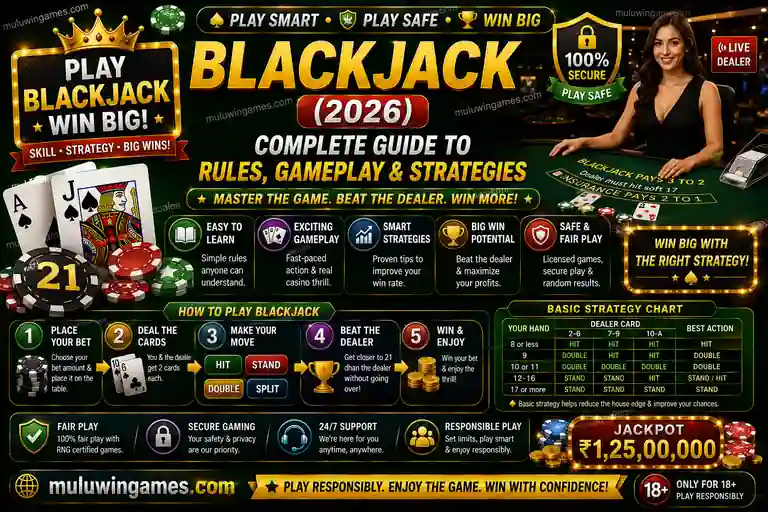
Blackjack Guide (2026): Rules, Gameplay, Card Values, Strategy Basics & Safety
Blackjack is one of the world’s most recognized casino card games. It combines straightforward rules with player decision-making, making it popular among both beginners and experienced players. Today, blackjack is available in land-based casinos, online casino platforms and live dealer environments, with numerous variations that follow similar core principles.
Unlike many games that rely entirely on automated gameplay, blackjack allows players to make decisions throughout each round. Understanding card values, basic actions and table rules can help new players understand how the game works before participating.
This guide explains blackjack rules, gameplay, common terminology, popular variations and responsible gaming practices. Muluw.in is an independent informational website and is not the official website of Mulu Win or any gaming operator.
AI Summary
Blackjack is a card game where players aim to build a hand value closer to 21 than the dealer without exceeding 21. During each round, players may choose actions such as Hit, Stand, Double Down or Split, depending on the cards they receive and the table rules. Different blackjack variants may use different rule sets, so understanding the published rules is essential. No strategy guarantees winning outcomes, and blackjack should always be enjoyed responsibly.
Key Takeaways
- Blackjack is one of the most popular casino card games worldwide.
- The objective is to finish closer to 21 than the dealer without going over.
- Number cards generally count at face value, while face cards count as 10.
- An Ace can usually count as either 1 or 11 depending on the hand.
- Players make decisions throughout the round based on the cards dealt.
- Different blackjack variants may use different rules.
- No betting system or strategy guarantees long-term success.
- Responsible gaming and account security remain important.
What Is Blackjack?
Blackjack is a comparing card game played between one or more players and a dealer. The goal is to achieve a hand value that is higher than the dealer’s without exceeding 21. If a player’s total goes above 21, the hand is commonly referred to as a “bust.”
The game is popular because it combines simple rules with player choices. Unlike games where the outcome is entirely passive, blackjack requires players to decide whether to take another card, keep their current hand or use other available options according to the table rules.
How Blackjack Works
Although individual rule variations exist, most blackjack games follow a similar sequence.
- A new round begins.
- Cards are dealt to the player and the dealer.
- The player reviews the current hand.
- The player chooses an available action such as Hit or Stand.
- The dealer completes the hand according to the table rules.
- The final hand values are compared.
- The round is settled according to the published rules.
Card Values in Blackjack
| Card | Typical Value |
|---|---|
| 2–10 | Face value. |
| Jack | 10 |
| Queen | 10 |
| King | 10 |
| Ace | 1 or 11, depending on the hand. |
Common Player Actions
| Action | Description |
|---|---|
| Hit | Request another card. |
| Stand | Keep the current hand. |
| Double Down | An optional action available under certain table rules. |
| Split | Separate matching cards into two hands when permitted. |
| Surrender | Available only on some blackjack tables. |
Popular Blackjack Variants
- Classic Blackjack
- European Blackjack
- American Blackjack
- Single Deck Blackjack
- Multi-Deck Blackjack
- Live Dealer Blackjack
- Speed Blackjack
Although these games share the same objective, individual rules may differ. Always review the table information before participating.
If you’re exploring other casino categories, you may also enjoy our guides on Casino, Live Games, Slots, Fishing Games and Colour Prediction.
Continue to Part 2: The next section explains blackjack terminology, dealer rules, common myths, strategy basics, online safety and responsible gaming.
Understanding the Dealer’s Role in Blackjack
The dealer plays an important role in every blackjack round, but the dealer does not make decisions in the same way as a player. Instead, the dealer generally follows predetermined table rules that specify when another card must be drawn and when the dealer must stop.
The exact dealer rules can vary between blackjack versions. For example, some tables may require different treatment of a particular soft hand. This is one reason players should check the rules displayed for the specific blackjack game rather than assuming every table operates identically.
Player vs Dealer
| Feature | Player | Dealer |
|---|---|---|
| Decision Making | Chooses from available actions. | Usually follows predetermined rules. |
| Hit | Chosen by the player when permitted. | Determined by table rules. |
| Stand | Chosen by the player. | Determined by table rules. |
| Split | May be available to the player. | Not a normal dealer action. |
| Double Down | May be available under the rules. | Not a normal dealer action. |
What Is a Natural Blackjack?
A natural blackjack generally refers to an initial two-card hand consisting of an Ace together with a card valued at 10, such as a 10, Jack, Queen or King. This produces a total value of 21 with the first two cards.
A natural blackjack can be treated differently from a hand that reaches 21 using three or more cards. The exact settlement and payout rules vary by table, so users should check the game’s published information.
Hard Hands and Soft Hands
Understanding the difference between hard and soft hands is useful when learning blackjack terminology.
Hard Hand
A hard hand either contains no Ace or contains an Ace that can only be counted as 1 without causing the total to exceed 21.
Soft Hand
A soft hand contains an Ace that can currently be counted as 11 without making the hand exceed 21.
For example, an Ace and a 6 can normally be treated as a soft 17 because the Ace can count as 11. If another card changes the total, the Ace may instead be counted as 1.
| Example Hand | Possible Value | Type |
|---|---|---|
| Ace + 6 | 7 or 17 | Soft Hand |
| 10 + 7 | 17 | Hard Hand |
| Ace + 9 | 10 or 20 | Soft Hand |
| King + 8 | 18 | Hard Hand |
What Happens When a Player Busts?
A player busts when the hand value exceeds 21. Under standard blackjack rules, a busted player loses that hand regardless of what subsequently happens to the dealer’s hand.
This rule is one reason decisions matter in blackjack. Taking another card may improve a low hand, but it can also push the total beyond 21.
Understanding Hit and Stand
Hit and Stand are the two most fundamental decisions in blackjack.
Hit
Choosing Hit requests another card. The new card is added to the existing hand total. Depending on the result, the player may then be able to make another decision.
Stand
Choosing Stand means the player keeps the current total and takes no additional cards. Play then continues according to the table rules.
Learning when these actions are available is one of the first steps in understanding blackjack.
How Splitting Works
Some blackjack games allow a player to split an initial pair into two separate hands. Additional cards are then dealt to each hand, and the hands are generally played separately.
Rules concerning splitting can vary considerably. A particular table may specify:
- Which cards can be split.
- Whether a hand can be split more than once.
- Special rules for splitting Aces.
- Whether doubling after a split is permitted.
- How a 21 formed after splitting is treated.
Because these details can affect gameplay, users should read the table rules rather than applying assumptions from another blackjack version.
What Does Double Down Mean?
Double Down is an optional blackjack action available under certain rules. It typically involves increasing the original stake and receiving one additional card before the hand automatically stands.
The hands on which doubling is permitted vary by game. Some tables provide broad flexibility, while others restrict the option to particular starting totals.
Understanding availability is different from knowing whether a particular decision will produce a successful result. No blackjack action guarantees that the next card will be favorable.
What Is Surrender?
Surrender is available only in certain blackjack variants. When permitted, it allows a player to end a hand early under specific conditions and receive the treatment described in that table’s rules.
There are different surrender rule variations, so players should not assume that the option works identically across platforms.
What Is Insurance in Blackjack?
Insurance is a side option that may be offered when the dealer’s visible card is an Ace. It is separate from the player’s main hand and has its own settlement rules.
New players sometimes misunderstand insurance as a general protection feature. It is better understood as a separate side wager tied to a specific dealer outcome. Its availability and settlement should be reviewed in the table rules.
Blackjack Basic Strategy Explained
When people refer to blackjack basic strategy, they generally mean a mathematically derived set of decisions based on the player’s hand, the dealer’s visible card and the rules of the particular blackjack variation.
Basic strategy should not be confused with a guaranteed winning system. It is designed to guide decisions under specific mathematical assumptions, but it cannot predict which card will appear next or guarantee that an individual hand will win.
Strategy recommendations can also change depending on factors such as:
- The number of decks.
- Dealer drawing rules.
- Whether doubling is restricted.
- Whether surrender is available.
- Rules concerning split hands.
This is why a strategy chart designed for one set of blackjack rules may not perfectly apply to another.
Does Blackjack Involve Skill or Luck?
Blackjack includes both player decision-making and uncertain card outcomes. Players can choose actions based on the information available to them, but they cannot control which card will be dealt next.
This makes blackjack different from games in which the user makes almost no decisions. However, the presence of strategic choices should not be interpreted as meaning that winnings can be guaranteed.
Common Blackjack Myths
| Myth | Reality |
|---|---|
| A losing streak means a win is due. | Previous hands do not guarantee the result of the next hand. |
| Always copying the dealer guarantees success. | The player and dealer operate under different rules. |
| Basic strategy guarantees winnings. | Basic strategy can guide decisions but cannot guarantee outcomes. |
| Changing tables resets your luck. | Moving to another table does not guarantee better results. |
| Increasing the stake after a loss guarantees recovery. | Increasing stakes can increase financial risk and does not guarantee recovery. |
| Online software can reveal the next card. | Claims of guaranteed card prediction should be treated cautiously. |
Why Chasing Losses Is Risky
One potentially harmful behavior in blackjack and other casino games is increasing participation after a loss in an attempt to recover previous money quickly. This is commonly known as chasing losses.
A previous loss does not make the next hand more likely to win. Increasing the amount committed to subsequent hands can instead increase the amount at risk.
Setting a predetermined entertainment budget and stopping when that limit is reached is a more responsible approach than continually increasing stakes.
Live Blackjack vs Digital Blackjack
| Feature | Live Blackjack | Digital Blackjack |
|---|---|---|
| Dealer | Real dealer via video stream | Software interface |
| Cards | Physical cards may be used | Digitally generated |
| Game Speed | Usually dealer-paced | Often faster |
| Video Streaming | Required | Generally not required |
| Interaction | May include dealer communication | Primarily interface-based |
Readers interested in dealer-streamed tables can explore our Live Games guide. For a broader overview of table games, see our Casino Games guide.
How to Check a Blackjack Table Before Playing
Instead of joining a table immediately, users can review its information first. Important details may include:
- Number of decks used.
- Dealer rules.
- Blackjack payout information.
- Splitting restrictions.
- Double Down rules.
- Surrender availability.
- Any side-bet rules.
- Minimum and maximum participation limits.
These details can differ even between blackjack tables available on the same platform.
Blackjack Scam and Security Awareness
Blackjack’s popularity also makes it a useful theme for misleading advertisements and fraudulent tools. Users should be skeptical of anyone claiming to possess software that can secretly predict cards or guarantee blackjack wins.
Potential warning signs include:
- “100% guaranteed” blackjack systems.
- Applications claiming to reveal the dealer’s hidden card.
- Modified APK files from unknown sources.
- Paid groups promising fixed daily profits.
- Fake support representatives requesting passwords.
- Requests for OTPs or other account verification codes.
Never provide passwords, OTPs, banking PINs or private wallet credentials to someone offering a blackjack strategy or account service.
Responsible Blackjack Habits
Blackjack should be approached as entertainment rather than as a guaranteed income opportunity. Good habits can help keep participation within reasonable limits.
- Set a spending limit before starting.
- Set a time limit for the session.
- Take regular breaks.
- Never borrow money to continue playing.
- Avoid increasing stakes simply to recover losses.
- Do not play while emotionally distressed or impaired.
- Stop when the predetermined limit is reached.
Understanding strategy can make blackjack more interesting, but strategy does not remove financial risk or uncertainty.
Explore More Gaming Guides
Blackjack is only one part of the wider casino gaming category. Readers researching different formats can explore Casino Games, Live Games, Slots, Fishing Games and Colour Prediction.
Continue to Part 3: The final section will cover additional blackjack terminology, frequently asked questions, beginner safety checks, a glossary, key takeaways, conclusion, disclaimer and responsible gaming guidance.
Blackjack FAQs
Blackjack is relatively easy to learn, but beginners often have questions about card values, dealer rules, strategy and online gameplay. The following answers cover some of the most common questions.
What is the main objective of blackjack?
The objective is generally to finish with a hand value closer to 21 than the dealer without exceeding 21. A player does not necessarily need to reach exactly 21 to win a hand. The result depends on the player’s final total, the dealer’s final total and the rules of the particular game.
What happens if my blackjack hand goes above 21?
A hand with a value above 21 is normally considered a bust. Under standard blackjack rules, a player who busts loses that hand even if the dealer later exceeds 21 as well.
What is a blackjack hand?
The term “blackjack” commonly refers to an initial two-card hand containing an Ace and a card valued at 10, such as a 10, Jack, Queen or King. Rules and payouts for a natural blackjack can vary between tables, so always check the published information.
Is an Ace worth 1 or 11?
An Ace can generally count as either 1 or 11 depending on which value works for the hand without causing it to exceed 21. This flexibility creates what are commonly known as soft hands.
What does Hit mean in blackjack?
Hit means requesting another card. The new card is added to the current hand total. If the total exceeds 21, the hand normally busts.
What does Stand mean?
Stand means keeping the current hand and requesting no additional cards. Once the player stands, gameplay continues according to the dealer and table rules.
What does Double Down mean?
Double Down is an optional action offered under certain blackjack rules. It typically involves increasing the original stake and receiving one additional card. Exact restrictions vary by game.
What does Split mean?
When permitted, Split allows an eligible starting pair to be separated into two hands. Each hand then receives additional cards and is generally played independently. Rules for splitting Aces, resplitting and doubling after a split can differ.
Does basic strategy guarantee that I will win?
No. Blackjack basic strategy uses mathematical principles to guide decisions under a particular set of rules. It cannot determine which cards will be dealt next and does not guarantee that an individual hand or session will be profitable.
Is live blackjack different from online blackjack?
Both formats generally share the same core objective. Live blackjack uses a real dealer streamed through video, while fully digital blackjack normally uses a software interface. Rules can vary in either format.
Can blackjack cards be predicted?
Players should be skeptical of software, apps or social media groups claiming that they can guarantee knowledge of upcoming cards. There is no dependable public tool that guarantees the outcome of future blackjack hands.
Blackjack Glossary for Beginners
| Term | Meaning |
|---|---|
| Blackjack | An initial two-card 21, usually consisting of an Ace and a 10-value card. |
| Hit | Request another card. |
| Stand | Keep the current hand without taking another card. |
| Bust | A hand whose total exceeds 21. |
| Double Down | An optional action involving an increased stake and typically one additional card. |
| Split | Separating an eligible pair into two individual hands. |
| Soft Hand | A hand containing an Ace that can currently count as 11 without exceeding 21. |
| Hard Hand | A hand without a flexible Ace value. |
| Dealer Upcard | The dealer card visible to the player. |
| Push | A tied result under rules where the player’s and dealer’s qualifying totals are equal. |
| Insurance | A separate side option that may be offered when the dealer shows an Ace. |
| Surrender | An optional rule allowing a player to end an eligible hand early under specified conditions. |
| Basic Strategy | A mathematically derived decision framework based on the player’s hand, dealer upcard and specific table rules. |
Beginner Checklist Before Playing Blackjack
New players can avoid unnecessary confusion by understanding the table before participating. A quick blackjack checklist includes:
- Learn the values of all cards.
- Understand the difference between Hit and Stand.
- Learn how an Ace can change value.
- Check the dealer’s drawing rules.
- Understand how a natural blackjack is treated.
- Review Split and Double Down restrictions.
- Check whether surrender is available.
- Understand any optional side bets separately from the main game.
- Review the minimum and maximum limits.
- Set personal time and spending limits before starting.
How to Evaluate an Online Blackjack Game
Users researching online blackjack should evaluate more than graphics and table design. Clear rules and transparent game information are particularly important because seemingly small rule differences can change how a blackjack variation operates.
Look for information covering:
- Game rules that are easy to find and understand.
- Number of decks used.
- Dealer drawing requirements.
- Natural blackjack treatment.
- Splitting and doubling rules.
- Side-bet explanations.
- Account security options.
- Responsible gaming controls.
If important rules are missing or unclear, consider learning more about the game before participating.
Blackjack vs Other Casino Games
Blackjack differs from many other casino games because player decisions form an important part of each hand. Comparing the basic formats helps illustrate these differences.
| Game | Main Mechanic | Player Decisions |
|---|---|---|
| Blackjack | Build a card total without exceeding 21 | Multiple decisions during a hand |
| Roulette | Wheel and numbered pockets | Selection before the wheel result |
| Baccarat | Comparison between designated hands | Generally fewer gameplay decisions |
| Slots | Digital reels and symbols | Limited decisions during each spin |
| Live Games | Real-time dealer gameplay | Depends on the individual game |
For a broader introduction to these categories, visit our Casino Games guide, Live Games guide and Slots guide.
Blackjack Safety and Scam Awareness
Online searches for blackjack strategies can lead users to websites, apps and social media accounts making unrealistic claims. Treat offers promising guaranteed profits or secret access to future cards with caution.
Potential warning signs include:
- Guaranteed blackjack winning systems.
- Software claiming to reveal hidden cards.
- Modified applications from unknown download sources.
- Paid prediction or signal groups.
- Requests to share your gaming account.
- Fake support accounts requesting an OTP.
- Pressure to send money to unlock a supposedly guaranteed strategy.
Never share your password, OTP, banking PIN or private wallet information with anyone claiming they can help you win blackjack games.
Why Bankroll Systems Do Not Guarantee Results
Some blackjack discussions promote progressive staking systems in which the amount committed changes after wins or losses. While such systems alter how money is distributed between hands, they do not control which cards appear.
Increasing a stake after a loss does not make the next hand more likely to succeed. Instead, it can expose a larger amount of money to another uncertain outcome.
For responsible gaming, a predetermined entertainment budget is generally more useful than attempting to recover losses through increasingly large stakes.
Related Guides on Muluw.in
Readers interested in blackjack may also want to explore the following independent educational resources:
- Casino Games
- Live Games
- Slots
- Fishing Games
- Colour Prediction
- Wingo Game
- K3 Game
- 5D Game
- TRX Game
- Mulu Win Lottery Games
- Mulu Win Review
Key Blackjack Takeaways
- The main blackjack objective is to beat the dealer without exceeding 21.
- Number cards generally use their face values, while face cards count as 10.
- An Ace can commonly count as either 1 or 11.
- Hit and Stand are the most fundamental blackjack actions.
- Split, Double Down, Insurance and Surrender depend on table rules.
- Blackjack basic strategy does not guarantee winnings.
- Different blackjack variants can use different rules.
- Previous hands do not guarantee future card outcomes.
- Claims of guaranteed blackjack prediction tools should be treated cautiously.
- Responsible limits are an important part of safer gaming.
Conclusion
Blackjack remains one of the best-known casino card games because its basic objective is relatively simple while its decision-making can provide additional depth. Players attempt to build a stronger qualifying hand than the dealer without exceeding 21, using actions such as Hit, Stand, Split or Double Down when permitted.
Learning blackjack properly involves more than memorizing the value of the cards. Players should understand soft and hard hands, dealer rules, natural blackjack, splitting restrictions and the differences between blackjack variations. Reading the specific table rules is particularly important because not every blackjack game operates identically.
Strategy can help explain the mathematical decision-making behind blackjack, but it should never be confused with certainty. No legitimate strategy can guarantee that a particular card will appear or that a session will result in a profit.
Muluw.in provides independent educational information about blackjack and other gaming topics so readers can understand game mechanics, common terminology, online security risks and responsible gaming principles before making their own decisions.
Disclaimer
This Blackjack guide is provided for informational and educational purposes only. Muluw.in is an independent gaming information website and is not the official website of Mulu Win, a blackjack provider, casino operator or gaming platform.
Muluw.in does not operate blackjack tables, process deposits or withdrawals, provide guaranteed betting systems or guarantee winnings. Blackjack rules, features and availability can vary between platforms and may change over time. Readers should verify current information directly with the platform they choose to use.
Online gaming rules and availability vary by jurisdiction. Readers are responsible for understanding and following requirements that apply in their location.
Responsible Gaming Reminder
Blackjack should be treated as entertainment rather than employment, investment or a dependable way to earn money. Set clear time and spending limits before participating, never use money needed for essential expenses, and avoid borrowing money for gaming.
Do not chase losses by increasing stakes in an attempt to recover money quickly. If gaming begins interfering with your finances, relationships, work, education or everyday responsibilities, stop participating and consider seeking appropriate support.