
Baccarat (2026): Complete Guide to Rules, Player, Banker & Safety
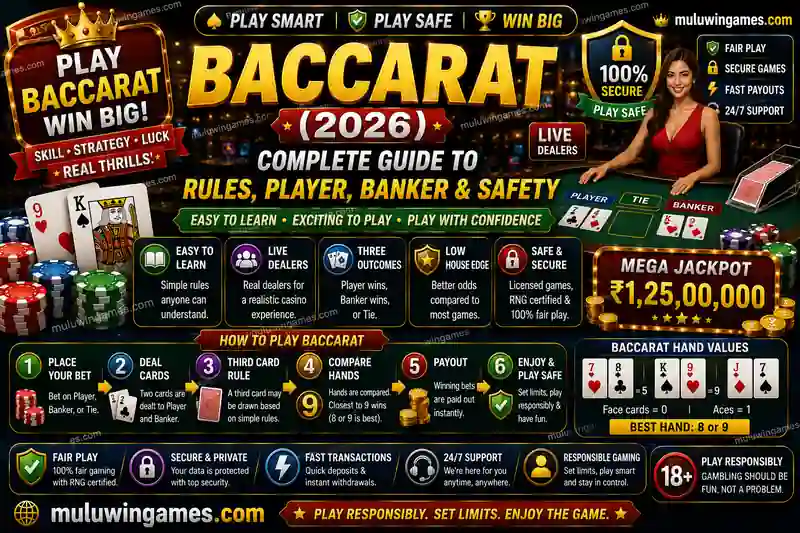
Baccarat Guide (2026): Rules, Gameplay, Card Values, Bets & Safety
Baccarat is one of the best-known casino card games and is commonly available in both traditional and online live dealer formats. Although the game may initially look complicated, its basic structure is relatively straightforward once you understand the Player hand, Banker hand, card values and drawing rules.
Unlike blackjack, where players regularly decide whether to Hit or Stand, standard baccarat normally follows predetermined rules for drawing additional cards. The main task for a participant is generally to understand the available selections and how the final hand totals are calculated.
This independent guide explains how baccarat works, card values, Player and Banker hands, Tie selections, third-card rules, popular baccarat variations and common terminology. It also covers scam awareness and responsible gaming. Muluw.in is an independent informational gaming website and is not the official website of Mulu Win, a baccarat provider, casino operator or gaming platform.
AI Summary
Baccarat is a comparing card game built around two designated hands: Player and Banker. The objective of each hand is to finish as close as possible to 9 according to baccarat’s special card-value system. Tens and face cards count as zero, Aces count as one, and other cards use their numerical value. Drawing decisions are normally controlled by fixed game rules rather than by the player. No strategy can guarantee a winning baccarat result.
Key Takeaways
- Baccarat compares two designated hands called Player and Banker.
- The hand closest to 9 generally wins the round.
- Aces normally count as 1.
- Cards 2 through 9 generally use their face values.
- 10, Jack, Queen and King normally count as zero.
- Only the final digit of a two-digit total is normally used.
- Additional cards are generally determined by fixed drawing rules.
- Player, Banker and Tie are common standard selections.
- Previous baccarat results do not guarantee future outcomes.
- Responsible gaming limits remain important.
What Is Baccarat?
Baccarat is a casino card game in which two designated hands are compared: the Player hand and the Banker hand. Despite these names, the Player hand does not necessarily represent the person participating, and the Banker hand does not necessarily represent a casino employee.
They are simply the traditional names assigned to the two sides of the game.
The objective is to determine which hand finishes closer to a total of 9 under baccarat’s card-counting rules. A Tie may occur when both hands finish with the same qualifying total.
How Baccarat Works
A standard baccarat round generally follows a structured sequence.
- A new baccarat round opens.
- The available selections are displayed.
- Selections close before cards are dealt.
- Cards are dealt to the Player and Banker hands.
- The initial totals are calculated.
- Additional cards may be dealt according to the game’s predetermined drawing rules.
- The final Player and Banker totals are compared.
- The round is settled according to the published rules.
Because the drawing procedure is largely predetermined, participants usually do not decide whether the Player or Banker hand should take another card.
Baccarat Card Values
Baccarat uses a different scoring method from games such as blackjack. Understanding these card values is one of the most important steps for beginners.
| Card | Baccarat Value |
|---|---|
| Ace | 1 |
| 2 | 2 |
| 3 | 3 |
| 4 | 4 |
| 5 | 5 |
| 6 | 6 |
| 7 | 7 |
| 8 | 8 |
| 9 | 9 |
| 10 | 0 |
| Jack | 0 |
| Queen | 0 |
| King | 0 |
How Baccarat Hand Totals Are Calculated
Baccarat totals are calculated using only the final digit when the combined value reaches 10 or more. This means that a baccarat hand can never have a final qualifying total above 9.
Example 1: 4 + 3
A 4 and a 3 produce a total of 7. The baccarat hand value is therefore 7.
Example 2: 7 + 8
The cards total 15. Baccarat uses only the final digit, so the hand value becomes 5.
Example 3: King + 9
A King has a baccarat value of zero. Therefore, King + 9 produces a hand value of 9.
Example 4: 6 + 6
The cards total 12. Only the final digit counts, making the baccarat total 2.
| Cards | Arithmetic Total | Baccarat Total |
|---|---|---|
| 4 + 3 | 7 | 7 |
| 7 + 8 | 15 | 5 |
| King + 9 | 9 | 9 |
| 6 + 6 | 12 | 2 |
| 9 + 8 | 17 | 7 |
What Are the Player and Banker Hands?
The terms Player and Banker can be confusing for someone learning baccarat for the first time. They refer to the two hands being compared rather than necessarily describing the people involved.
Player Hand
The Player hand is one of the two designated baccarat hands. Cards are dealt to it according to the game’s rules.
Banker Hand
The Banker hand is the second designated hand. Its drawing procedure can depend on both its current total and, in some circumstances, the Player hand’s third card.
Users do not generally take direct control of either hand’s drawing decisions in standard baccarat.
What Is a Tie in Baccarat?
A Tie occurs when the Player and Banker hands finish with the same qualifying total. For example, if both hands finish on 7, the round is a Tie.
Many baccarat tables provide a separate Tie selection. It should be understood independently from Player and Banker because its probability and payout structure differ.
What Is a Natural in Baccarat?
A natural commonly refers to an initial two-card total of 8 or 9. When a natural occurs, standard baccarat drawing procedures generally determine how the round proceeds without the usual additional-card sequence.
Because rule variations exist, users should review the specific baccarat table information for exact procedures.
Understanding the Third-Card Rule
One of the most misunderstood parts of baccarat is the third-card rule. Beginners sometimes assume they must decide whether another card should be drawn. In standard baccarat, this decision is normally made automatically according to predetermined rules.
The Player hand follows one set of drawing conditions. The Banker hand uses a more detailed set of conditions that can depend on the Player’s third card.
The important beginner takeaway is simple: you normally do not need to memorize the complete third-card table just to understand a baccarat round. The dealer or game system applies the rules automatically.
Common Baccarat Selections
| Selection | General Meaning |
|---|---|
| Player | The Player hand finishes with the qualifying winning total. |
| Banker | The Banker hand finishes with the qualifying winning total. |
| Tie | Both hands finish with the same qualifying total. |
Some baccarat versions also offer optional side bets. These should be evaluated separately because they can have different rules, probabilities and payouts from the three primary selections.
Does “Banker” Mean You Are Betting Against the Casino?
No. Banker is simply the traditional name of one baccarat hand. Selecting Banker does not mean that the participant becomes the casino, lender or dealer.
Likewise, selecting Player does not necessarily mean choosing your own personal hand. Player and Banker are labels used to identify the two sides whose totals are compared.
Why Baccarat Feels Different From Blackjack
Baccarat and blackjack both use playing cards, but their gameplay is substantially different.
| Feature | Baccarat | Blackjack |
|---|---|---|
| Main Target | Closest to 9 | Beat dealer without exceeding 21 |
| Face Cards | Value 0 | Usually value 10 |
| Ace | Value 1 | Usually 1 or 11 |
| Drawing Decisions | Usually predetermined | Player commonly chooses Hit or Stand |
| Main Hands | Player and Banker | Player versus dealer |
For a detailed explanation of the other format, see our Blackjack guide.
Popular Types of Baccarat
Several versions of baccarat exist. Availability depends on the platform and game provider.
Punto Banco
Punto Banco is the baccarat format commonly encountered in many casinos and online platforms. The Player and Banker hands follow predetermined drawing rules.
Mini Baccarat
Mini Baccarat generally follows similar core principles but is presented on a smaller table and may operate at a faster pace.
Live Baccarat
Live Baccarat uses a real dealer and physical cards presented through live video streaming. The interface normally displays Player, Banker and Tie options alongside the video.
Speed Baccarat
Speed Baccarat is designed to complete rounds more quickly than some traditional live tables. The core rules may remain similar while the presentation is accelerated.
Other Baccarat Variants
Some providers offer modified versions with different side bets, presentation styles or rule variations. Always review the specific rules rather than assuming every game labelled baccarat operates identically.
Live Baccarat vs Digital Baccarat
| Feature | Live Baccarat | Digital Baccarat |
|---|---|---|
| Dealer | Real dealer via video | Software interface |
| Cards | Physical cards may be used | Digital game system |
| Video Streaming | Yes | Usually not required |
| Round Speed | Dealer-paced | Often faster |
| Interaction | May include dealer interaction | Primarily interface-based |
To understand how real-time dealer tables operate more broadly, read our Live Games guide. Our Casino Games guide covers additional casino categories.
What Is a Baccarat Roadmap?
Many baccarat interfaces display previous results using charts sometimes called roads or roadmaps. These visual displays organize historical Player, Banker and Tie results in different ways.
They can help users see what happened during previous rounds, but they should not be interpreted as a guaranteed prediction system.
A sequence of several Banker results does not prove that Player must come next. Likewise, a repeating visual pattern does not guarantee that the next round will continue that pattern.
Can Baccarat Results Be Predicted?
Users should be cautious of websites, apps or messaging groups claiming they can guarantee upcoming baccarat results. Historical outcomes do not provide certainty about the next round.
Common questionable claims include:
- Guaranteed baccarat signals.
- AI baccarat prediction software.
- Fixed Banker or Player results.
- Secret dealer information.
- Guaranteed daily earnings.
Using words such as AI, algorithm or professional system does not demonstrate that future baccarat outcomes can be known with certainty.
Common Baccarat Myths
| Myth | Reality |
|---|---|
| Player must win after several Banker results. | Previous rounds do not guarantee the next outcome. |
| Roadmaps reveal future results. | Roadmaps display historical information. |
| A particular dealer creates better outcomes. | Dealer identity does not guarantee future results. |
| A betting system guarantees recovery. | Changing stake sizes cannot guarantee future outcomes. |
| AI software can guarantee the next hand. | Guaranteed prediction claims should be treated cautiously. |
Baccarat Safety and Scam Awareness
Baccarat-related searches can expose users to fake prediction services, unofficial applications and social media accounts making unrealistic promises. Be especially cautious when someone requests access to your gaming account or personal financial information.
- Never share your account password.
- Never provide OTP verification codes to another person.
- Avoid modified APK files from unknown sources.
- Do not trust guaranteed-result groups.
- Verify website addresses before logging in.
- Be cautious of pressure to transfer money immediately.
Responsible Baccarat Habits
Baccarat should be treated as entertainment rather than as a guaranteed method of earning money. Setting limits before participating can reduce the risk of making emotional decisions during a session.
- Set a fixed entertainment budget.
- Decide on a time limit before starting.
- Never borrow money to continue playing.
- Avoid chasing previous losses.
- Do not increase stakes because an outcome appears “due.”
- Take regular breaks.
- Stop when your predetermined limit has been reached.
Related Guides on Muluw.in
Readers learning about baccarat can also explore our Blackjack, Roulette, Casino Games, Live Games and Slots guides.
Continue to Part 2: The next section will explain baccarat probabilities, Banker commission, house edge, third-card rules in more detail, roadmaps, popular betting systems, live baccarat features, security and responsible gaming.
Understanding Baccarat Probability
Baccarat is easier to understand when probability is separated from prediction. Probability describes the mathematical likelihood of different outcomes over many rounds. It does not tell a player with certainty whether Player, Banker or Tie will occur in the next individual round.
In standard Punto Banco, the Player and Banker hands follow fixed drawing rules. Because those rules are not identical, the mathematical probabilities of the two hands are also slightly different.
This is an important distinction for beginners. Seeing a particular result several times in a row does not change the rules governing the next round or make the opposite result automatically due.
Why Banker and Player Are Not Mathematically Identical
The words Player and Banker might make the two sides appear symmetrical, but their drawing procedures differ. The Player hand follows a relatively simple drawing rule, while the Banker hand’s third-card procedure can depend on its own total and, in some situations, the value of the Player’s third card.
Because of these differences, standard baccarat typically gives the Banker hand a slightly higher probability of winning than the Player hand before ties are considered.
That does not mean Banker will win every round, nor does it mean a Banker selection guarantees profit. It simply describes the long-term mathematics of the standard game.
What Is the House Edge in Baccarat?
The house edge describes the mathematical advantage created by a casino game’s rules and payout structure over the long term. Baccarat’s house edge depends on which selection is made and the exact rules of the table.
In a common standard commission-based baccarat format, the Banker selection is often associated with a house edge of approximately 1.06%, while the Player selection is approximately 1.24%. A standard Tie selection commonly carries a substantially higher house edge, although the exact figure depends on the published Tie payout.
| Common Selection | Approximate Standard House Edge | Important Note |
|---|---|---|
| Banker | About 1.06% | Common commission rules assumed |
| Player | About 1.24% | Can vary with game rules |
| Tie | Usually much higher | Depends significantly on the Tie payout |
These figures are educational references for common baccarat rules rather than predictions of individual results. Different baccarat variations, side bets and commission structures can produce different mathematical values.
Why Baccarat Banker Bets May Include Commission
Standard baccarat often applies a commission to qualifying Banker wins because the Banker hand has a small mathematical advantage under the drawing rules.
A commonly encountered structure applies a 5% commission to a winning Banker selection, although specific tables may use different arrangements.
For example, some baccarat variants use modified payouts for particular Banker totals instead of applying the traditional commission structure. Always check the actual game rules before participating.
Commission vs No-Commission Baccarat
| Feature | Commission Baccarat | No-Commission Baccarat |
|---|---|---|
| Banker Win | May have a commission deducted | Usually uses an alternative payout rule |
| Core Objective | Closest hand to 9 | Closest hand to 9 |
| Drawing Rules | Predetermined | Predetermined according to variant |
| Special Conditions | Traditional commission structure | May modify certain Banker payouts |
The phrase “no commission” should not be interpreted as meaning that a game has no mathematical house advantage. It simply means the game uses a different settlement structure.
Baccarat Third-Card Rules Explained
The third-card rule is one of the most distinctive parts of baccarat. Fortunately, players generally do not need to make the drawing decisions themselves because the dealer or game software applies them automatically.
Player Hand Drawing Rule
Under common Punto Banco rules, if neither side has a natural, the Player hand generally draws another card when its initial total is between 0 and 5 and normally stands on 6 or 7.
If either hand has an initial natural 8 or 9, the standard natural rules apply instead.
Banker Hand Drawing Rule
The Banker procedure is more detailed. Whether the Banker receives a third card can depend on:
- The Banker’s current total.
- Whether the Player drew a third card.
- The value of the Player’s third card.
This procedure is automatically applied under standard baccarat rules, so beginners should focus on understanding the principle rather than trying to make the decision themselves.
Why the Third-Card Rule Matters
The third-card procedure helps explain why baccarat is not simply a 50/50 comparison between two identical hands. Player and Banker are governed by different drawing conditions, which influence their long-term probabilities.
Understanding this also helps prevent a common misconception: the dealer is not normally choosing whether to give a hand another card based on personal preference. The published baccarat rules determine the drawing sequence.
What Are Baccarat Roadmaps?
Many live baccarat tables display historical results using visual charts commonly called roads or roadmaps. These systems organize completed Player, Banker and sometimes Tie results into recognizable patterns.
Common baccarat road displays may include:
- Bead Plate or Bead Road
- Big Road
- Big Eye Boy
- Small Road
- Cockroach Pig
The names may sound unusual to beginners, but each is essentially a different way of organizing historical information.
What Is the Bead Plate?
The Bead Plate is generally one of the simplest baccarat history displays. It records completed results sequentially and may use different colours or symbols for Player, Banker and Tie.
Its main purpose is to show what has already happened during previous rounds.
What Is the Big Road?
The Big Road organizes Player and Banker outcomes into columns based on sequences and changes between the two sides. Ties may be marked separately depending on the interface.
Because the resulting chart can create visible patterns, some players attempt to use it to forecast future hands. However, a historical pattern does not guarantee that the next round will follow the same visual sequence.
Derived Roads Explained
Displays such as Big Eye Boy, Small Road and Cockroach Pig are derived from the structure of previous results rather than directly representing a simple Player-versus-Banker sequence.
They can provide another visual perspective on historical patterns, but they should not be confused with reliable prediction tools.
Can Baccarat Roadmaps Predict the Next Result?
No baccarat roadmap can guarantee the outcome of the next round. Roadmaps organize previous information; they do not reveal future cards.
For example, a chart showing a long Banker sequence does not prove that Banker will continue, nor does it prove that Player must occur next.
Both conclusions attempt to convert historical observations into certainty about a future uncertain event.
Common Baccarat Betting Systems
Like roulette, baccarat is associated with numerous staking systems. Most of these systems change the amount committed after wins or losses rather than changing the underlying game.
Flat Betting
A flat approach uses the same predetermined amount for each qualifying selection. While this can make spending easier to track, it does not guarantee favourable results.
Martingale
The Martingale generally involves increasing the amount after an unsuccessful result in an attempt to recover previous losses after a later win.
The major risk is that an extended losing sequence can cause the required amount to increase rapidly. Table limits and finite budgets also prevent unlimited progression.
Reverse Martingale
A Reverse Martingale increases amounts following successful results rather than unsuccessful ones. This changes the progression but does not influence which cards will appear next.
Fibonacci Progression
Some players adjust their amounts according to the Fibonacci numerical sequence. As with other staking systems, this changes money management rather than the probability of the underlying baccarat result.
Can Any Baccarat System Guarantee Profit?
No staking system can guarantee profit simply by changing the amount used after each result. The Player and Banker drawing rules remain the same regardless of whether someone follows Martingale, Fibonacci, flat betting or another progression.
A system may appear successful over a short sequence, but short-term results do not prove that the system can overcome the game’s long-term mathematical structure.
Understanding Baccarat Streaks
Baccarat history boards can sometimes display long sequences of Player or Banker results. These streaks can be visually striking and may encourage players to believe they have identified a predictable pattern.
Two opposite beliefs commonly appear:
- A streak will definitely continue.
- A streak has lasted too long and must immediately end.
Neither belief guarantees the next outcome. Previous rounds can be recorded and analyzed historically, but they do not create certainty about the cards that will appear next.
What Is the Gambler’s Fallacy in Baccarat?
The gambler’s fallacy occurs when someone believes that an outcome becomes necessary because the opposite result occurred repeatedly.
Imagine a history board displaying:
- Banker
- Banker
- Banker
- Banker
- Banker
A player might conclude that Player is now guaranteed because Banker has appeared too many times. The previous sequence, however, does not create a rule forcing Player to win the next hand.
Live Baccarat Features
Live Baccarat combines standard baccarat rules with real-time video streaming. A professional dealer manages physical cards while players follow the round remotely through an online interface.
Features may include:
- Live video of the dealer and table.
- Player, Banker and Tie controls.
- Countdown timers.
- Historical result boards.
- Baccarat roadmaps.
- Multiple camera views.
- Table information.
- Chat functionality where available.
Readers who want to understand this format in more detail can visit our Live Games guide.
Speed Baccarat
Speed Baccarat generally reduces the time required to complete each round. The dealer may reveal cards more quickly, and the participation window may be shorter than at a standard table.
Faster gameplay does not necessarily mean better outcomes. It can simply result in more rounds occurring during the same period of time.
Users who choose faster formats should pay particular attention to their time and spending limits because decisions can occur more frequently.
Baccarat Side Bets
Some baccarat tables offer additional selections beyond Player, Banker and Tie. Examples can vary widely between providers and may relate to pairs, card combinations, margins or other outcomes.
Side bets should not be assumed to have the same probabilities or house edge as the main baccarat selections.
Before using any optional feature, check:
- What outcome qualifies.
- The published payout.
- Whether the side bet is independent of the main selection.
- Any special settlement rules.
- Available mathematical information.
Choosing a Baccarat Table
Different baccarat tables can look similar while using different rules. Before participating, users should review:
- Whether the table uses commission or no-commission rules.
- The Banker payout structure.
- The Player payout structure.
- The Tie payout.
- Available side bets.
- Minimum and maximum limits.
- Whether the game is live or digital.
- Any special variant rules.
This information is more useful than choosing a table based solely on recent results or perceived lucky streaks.
Live Baccarat vs Live Blackjack vs Live Roulette
| Feature | Baccarat | Blackjack | Roulette |
|---|---|---|---|
| Main Mechanic | Compare Player and Banker totals | Build a hand toward 21 | Numbered spinning wheel |
| Main Target | Closest to 9 | Beat dealer without busting | Selected outcome matches wheel result |
| Player Drawing Decisions | Normally predetermined | Yes | Not applicable |
| Historical Charts | Commonly emphasized | Less central | Frequently displayed |
For deeper explanations, see our Blackjack guide, Roulette guide and Casino Games guide.
Baccarat Prediction Scams
Online baccarat communities sometimes promote supposedly guaranteed Player or Banker signals. Some services use terms such as artificial intelligence, algorithm, insider information or dealer tracking to make their claims appear more credible.
Warning signs include:
- “100% accurate baccarat signals.”
- “Guaranteed Banker predictions.”
- “Fixed live baccarat results.”
- “Secret casino algorithm access.”
- “Guaranteed daily income.”
- Requests for payment to unlock the next result.
- Requests for account passwords or OTPs.
No legitimate educational service needs your password, OTP, banking PIN or private wallet credentials to explain baccarat.
Baccarat Account Security
If users choose to access an online gaming platform, basic account-security practices remain important.
- Verify the website address carefully.
- Use a strong and unique password.
- Enable additional authentication if available.
- Never share OTP codes.
- Avoid unofficial or modified applications.
- Keep browsers and devices updated.
- Do not give prediction groups access to your account.
- Be cautious with unsolicited links received through messaging apps.
Why Chasing Baccarat Losses Is Risky
An unsuccessful round does not make the next Player or Banker result more favourable. Increasing the next amount simply because money was lost previously can therefore increase financial exposure without guaranteeing recovery.
Progressive staking systems can make this problem worse because the required amount may grow rapidly during an extended unsuccessful sequence.
Setting a fixed entertainment budget before starting and stopping when that limit is reached is a more responsible approach.
Responsible Baccarat Tips
- Understand baccarat card values before participating.
- Review the table’s commission and payout rules.
- Do not treat roadmaps as guaranteed predictions.
- Set a spending limit before the session.
- Set a separate time limit.
- Never borrow money to continue playing.
- Avoid chasing losses.
- Take breaks during longer sessions.
- Do not treat baccarat as a dependable source of income.
- Ignore claims of guaranteed Player or Banker signals.
Continue Exploring Muluw.in
Baccarat forms part of the wider casino and live gaming category. Readers can continue learning through our Blackjack, Roulette, Casino Games, Live Games and Slots guides.
Continue to Part 3: The final section will cover baccarat FAQs, terminology, a beginner checklist, roadmaps and myths, security checks, key takeaways, conclusion, disclaimer and responsible gaming guidance.
Baccarat Frequently Asked Questions
Baccarat is relatively simple once the Player, Banker and Tie structure is understood, but beginners often have questions about card values, roadmaps, third-card rules and live dealer formats. The following FAQs cover the most common points.
What is the main objective of baccarat?
The goal is to determine whether the Player hand or Banker hand finishes closer to 9 according to baccarat’s card-value rules. A Tie occurs when both hands finish with the same qualifying total.
Is Banker a person?
No. In baccarat, Banker is simply the name of one of the two designated hands. It does not necessarily represent the casino, dealer or a specific participant.
What does Player mean?
Player is the traditional name of the other baccarat hand. It does not automatically mean the user’s personal hand. Player and Banker are labels used to compare the two sides of the round.
What are face cards worth in baccarat?
10, Jack, Queen and King normally have a value of zero. Aces normally count as 1, while cards 2 through 9 use their face values.
Why do baccarat totals only go up to 9?
If a card total reaches 10 or more, baccarat generally uses only the final digit. For example, a total of 16 becomes 6, while a total of 14 becomes 4.
What is a natural in baccarat?
A natural generally refers to an initial two-card total of 8 or 9. Standard drawing rules then determine how the round proceeds.
Do players choose whether to draw a third card?
Usually not in standard Punto Banco. The Player and Banker drawing rules are predetermined, and the dealer or software applies them automatically.
What is a Tie?
A Tie occurs when the Player and Banker hands finish with the same qualifying total. Tie is commonly offered as a separate selection with its own payout and mathematical characteristics.
What are baccarat roadmaps?
Baccarat roadmaps are visual displays that organize previous Player, Banker and Tie results. They may include the Bead Plate, Big Road, Big Eye Boy, Small Road and Cockroach Pig.
Can roadmaps predict the next baccarat result?
No. Roadmaps show historical patterns, but they do not guarantee which hand will win the next round.
Is live baccarat different from digital baccarat?
Live baccarat uses a real dealer and physical cards shown through a live video stream. Digital baccarat generally uses a software-based interface. Both formats may follow similar core rules but can differ in presentation and table features.
Can AI predict baccarat results?
Be cautious of any service claiming guaranteed baccarat predictions using AI, algorithms or private signals. These claims do not provide reliable proof that future card outcomes can be known in advance.
Baccarat Glossary
| Term | Meaning |
|---|---|
| Player | One of the two designated baccarat hands. |
| Banker | The second designated baccarat hand. |
| Tie | A result where Player and Banker finish with the same qualifying total. |
| Natural | An initial two-card total of 8 or 9 under common baccarat rules. |
| Third-Card Rule | The predetermined rule that controls whether another card is drawn. |
| Punto Banco | A widely used form of baccarat in which drawing decisions are automatic. |
| Mini Baccarat | A smaller, often faster version of standard baccarat. |
| Commission | A deduction that may apply to qualifying Banker wins under certain rules. |
| No-Commission Baccarat | A baccarat variation using an alternative settlement structure instead of traditional commission. |
| Roadmap | A visual chart showing historical baccarat outcomes. |
| Bead Plate | A simple sequential display of completed results. |
| Big Road | A popular baccarat history chart showing result sequences. |
| Big Eye Boy | A derived roadmap built from historical pattern structure. |
| Small Road | Another derived roadmap used to visualize previous results. |
| Cockroach Pig | A secondary baccarat roadmap based on historical result structure. |
| House Edge | The long-term mathematical advantage created by game rules and payouts. |
Baccarat Beginner Checklist
Before participating in baccarat, beginners should understand the core rules rather than relying on prediction systems or recent streaks.
- Learn the value of every baccarat card.
- Understand Player, Banker and Tie.
- Know that totals use only the final digit.
- Understand what a natural 8 or 9 means.
- Remember that third-card decisions are normally automatic.
- Check whether the table uses commission or no-commission rules.
- Review the Tie payout and any side bets.
- Do not treat roadmaps as guaranteed forecasts.
- Set a personal time limit before starting.
- Set a personal entertainment budget.
Banker vs Player: Quick Comparison
| Feature | Banker | Player |
|---|---|---|
| Role | Designated baccarat hand | Designated baccarat hand |
| Drawing Rules | More detailed | Generally simpler |
| Common Standard House Edge | Usually slightly lower | Usually slightly higher |
| Commission | May apply on qualifying wins | Usually no traditional commission |
| Guaranteed Outcome? | No | No |
The exact rules can vary by baccarat version, so players should rely on the table’s published information rather than assuming every game uses the same payout structure.
What Makes Tie Different?
Tie is commonly presented alongside Player and Banker, but it behaves differently from those two primary selections. Tie generally has a lower probability of occurring and commonly carries a higher house edge depending on the payout structure.
This is why Tie should not simply be viewed as a third version of Player or Banker. It is a separate selection with different mathematics.
Baccarat Roadmaps: Useful or Misleading?
Roadmaps can be useful for reviewing historical results in an organized way. They can show whether recent rounds contained long runs, frequent changes between Player and Banker or repeated Tie outcomes.
The problem begins when historical charts are treated as forecasts.
Examples of misleading assumptions include:
- “Banker has appeared five times, so Player must come next.”
- “The Big Road pattern looks perfect, so it will continue.”
- “A Tie has not appeared recently, so it is due.”
- “The roadmap changed shape, so the next outcome is obvious.”
These interpretations attempt to convert past information into certainty about future cards.
Common Baccarat Myths Revisited
| Myth | Reality |
|---|---|
| Banker always wins more in every short session. | Long-term mathematical probability does not guarantee short-term results. |
| Player must follow a long Banker streak. | A previous streak does not force the next result. |
| Roadmaps reveal secret patterns. | Roadmaps organize completed results. |
| No-commission baccarat has no house edge. | No-commission refers to payout structure, not removal of the mathematical advantage. |
| A betting progression guarantees recovery. | Changing stakes cannot guarantee the next hand. |
| Live dealers can influence the outcome for individual players. | Legitimate tables should follow published procedures rather than personal preference. |
How to Evaluate a Baccarat Table
Before choosing a baccarat table, review the rules rather than relying on visual design or recent results. Important details include:
- Commission structure.
- Banker payout.
- Player payout.
- Tie payout.
- Side-bet availability.
- Minimum and maximum limits.
- Live or digital format.
- Speed or standard table format.
- Any special settlement rules.
Two baccarat tables may look almost identical while using different settlement conditions.
Baccarat Scam Awareness
Baccarat prediction scams often rely on technical-sounding language to create credibility. A seller may claim to use artificial intelligence, private algorithms, hacked casino data or inside dealer information.
Common warning signs include:
- “100% Banker signal accuracy.”
- “Guaranteed Player prediction.”
- “Fixed baccarat tables.”
- “Insider dealer information.”
- “Secret AI baccarat software.”
- “Guaranteed income every day.”
- Requests for payment before revealing a signal.
- Requests for your login credentials or OTP.
No legitimate educational resource needs access to your account or private financial credentials in order to explain baccarat.
Online Baccarat Security Checklist
- Verify the website address before logging in.
- Use a strong, unique password.
- Enable additional account protection if available.
- Never share OTP codes.
- Avoid unofficial APK files.
- Keep your browser and device updated.
- Do not let third-party prediction groups control your account.
- Be cautious with unsolicited links.
- Log out from shared devices.
Why Baccarat Should Not Be Treated as Income
Baccarat outcomes remain uncertain even when players understand the mathematics of Player, Banker and Tie. A lower house edge does not convert a casino game into a guaranteed earning method.
Short-term winning sequences can occur, but so can extended periods of unsuccessful results. Neither should be mistaken for a dependable income pattern.
Money required for food, rent, bills, debt payments, education or other essential expenses should not be used for gaming.
Why Chasing Losses Is Dangerous
After an unsuccessful sequence, players may feel pressure to increase their next stake in an attempt to recover previous losses. This can significantly increase financial exposure.
A previous loss does not make the next Banker or Player result more likely to succeed. Increasing the amount therefore does not create a guaranteed recovery.
If a predetermined budget has been reached, stopping is more responsible than trying to force a recovery through additional rounds.
Related Guides on Muluw.in
Readers interested in baccarat may also want to explore these independent gaming guides:
- Blackjack
- Roulette
- Casino Games
- Live Games
- Slots
- Fishing Games
- Colour Prediction
- Wingo Game
- K3 Game
- 5D Game
- TRX Game
- Mulu Win Review
Key Baccarat Takeaways
- Baccarat compares Player and Banker hands.
- The hand closest to 9 generally wins.
- Face cards and 10 normally count as zero.
- Aces normally count as 1.
- Only the final digit of totals above 9 is used.
- Third-card decisions are usually automatic.
- Banker and Player have slightly different long-term probabilities.
- Tie has different mathematical characteristics from Player and Banker.
- Roadmaps display history rather than guaranteed predictions.
- Streaks do not force future outcomes.
- No staking system guarantees recovery or profit.
- Prediction services promising certainty should be treated cautiously.
- Responsible time and spending limits are essential.
Conclusion
Baccarat remains one of the most recognizable casino card games because its basic structure is relatively easy to understand. Two designated hands, Player and Banker, are compared according to a simple scoring system where the qualifying total closest to 9 wins.
Beginners should focus on learning the card values, how totals are calculated, the difference between Player, Banker and Tie, and how automatic third-card rules work. Understanding commission structures and side bets is also important because not every baccarat table uses identical settlement rules.
Roadmaps and historical charts can make baccarat visually interesting, but they do not provide certainty about future outcomes. Likewise, staking systems can change how money is distributed across rounds but cannot force particular cards to appear.
Muluw.in provides independent educational gaming information designed to help readers understand baccarat rules, probabilities, terminology, common myths, online security risks and responsible gaming principles before making their own decisions.
Disclaimer
This Baccarat guide is provided for informational and educational purposes only. Muluw.in is an independent gaming information website and is not the official website of Mulu Win, a baccarat provider, casino operator or gaming platform.
Muluw.in does not operate baccarat tables, process deposits or withdrawals, sell prediction signals or guarantee winnings. Baccarat rules, payouts, commissions, side bets and availability can vary between platforms and may change over time. Readers should verify current information directly with the platform they choose to use.
Online gaming requirements vary by jurisdiction. Readers are responsible for understanding and following the laws and regulations applicable in their location.
Responsible Gaming Reminder
Baccarat should be treated as entertainment rather than employment, investment or a dependable method of generating income. Set firm time and spending limits before participating, never use money needed for essential expenses and never borrow money to continue playing.
Avoid chasing losses, increasing stakes because of recent streaks or relying on roadmap patterns as guaranteed predictions. If gaming begins affecting your finances, relationships, work, education or everyday responsibilities, stop participating and consider seeking appropriate support.